
Rubber Band Ball RFQs: Define the Finished Form
For a rubber-band ball order, identify the assembled form the supplier will deliver. Ask for its winding construction, any internal component and finished outside measurements. Clarify the object described by the catalogue’s 50 × 3 mm field, and keep an intact sample as the reference for the finished-form decision.
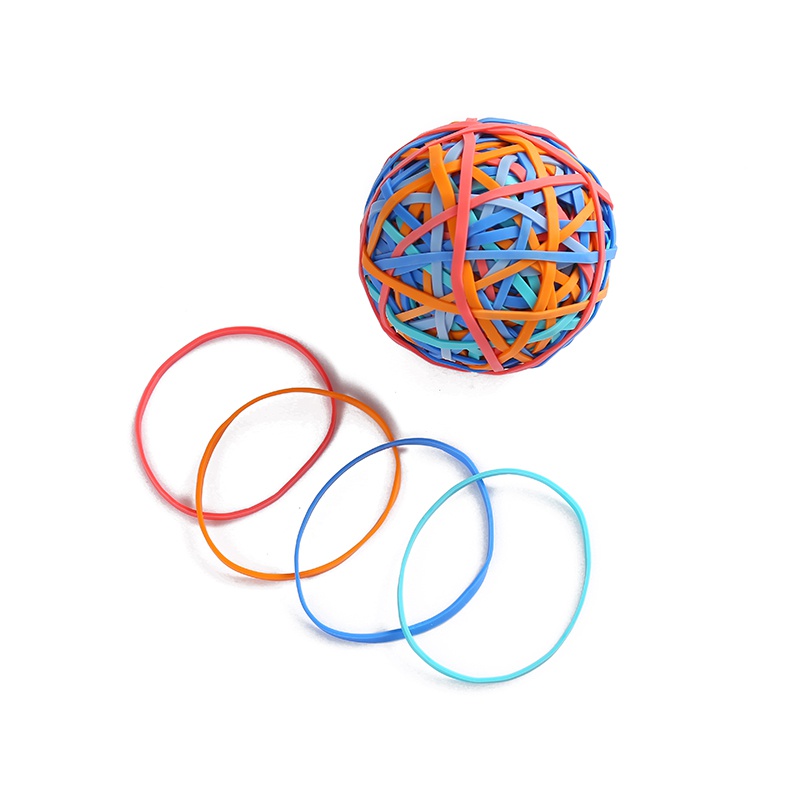
Official product-page reference showing an assembled ball beside loose bands. Confirm the finished construction, size basis and whether any loose bands are separately supplied.
Specify an assembled ball as the offered article
Wangxing lists a Synthetic Color Rubber Band Ball 150g/piece. The supplier describes a round form made by wrapping coloured bands in layers. Its fields state synthetic rubber, 150 g per piece and Size: 50 × 3 mm. The description also refers to disassembling the ball for office use.
For wholesale rubber band balls, define the assembled article the buyer expects to receive. Ask the supplier to identify the finished ball’s construction and outside form separately from the dimensions of the individual bands. A bare size pair does not explain whether it describes a band, the assembled ball or another measurement basis.
Clarify the winding construction
Ask the supplier how the offered ball is built and which construction reference applies to the quotation. Request confirmation of whether the assembly consists only of bands or includes another internal component. Keep that answer with the identified ball version instead of treating an exterior photograph as proof of the hidden structure.
Request a description or relevant sample evidence showing how the layers form the delivered article. Ask which details are fixed for the offer and which may vary between balls. The supplier’s layered-wrapping description gives the enquiry a starting point, but it does not state a winding specification or an agreed exterior-shape limit.
Identify the finished ball version and construction reference.
Clarify the layers and any internal component.
State which delivered-form features the sample approval will cover.
Official yellow catalogue reference. The picture supplies no scale or independently measured ball diameter and does not establish an accepted winding limit.
Request the finished dimensions with their own labels
Quote the catalogue’s 50 × 3 mm field exactly and ask the supplier to identify its measurement object and directions. Do not relabel the first number as finished-ball diameter or expand the second into an assumed thickness. If the field concerns an individual band, request the assembled ball’s outside dimensions separately.
For the finished form, ask what the supplier measures, how the ball is positioned and what condition applies during measurement. If the buyer needs the ball to fit a display, container or individual pack, provide that requirement separately and request the proposed finished-size range. The required fit should not be calculated from the catalogue’s unlabelled pair.
Finished-form field
Supplier response requested
Catalogue size pair
Object and directions described by 50 × 3 mm
Outside dimensions
Finished-ball measurements and relevant method
Construction
Layer description and any internal component
Shape range
Proposed acceptable variation for the assembled article
Sample identity
Ball version and condition covered by the review
Review an intact sample in the delivered condition
Ask for a sample representing the ball as it will be supplied. Request clear views of the complete form and any area needing clarification. Keep the supplier’s construction explanation beside that sample so purchasing can distinguish the assembled article from a loose-band assortment or a partially unwound demonstration.
The catalogue photographs show balls alongside loose bands. Ask whether those loose bands are simply presentation references or separately included items. For a sample review, record whether the photographed ball is intact and whether any bands have been removed. That keeps appearance comments associated with the condition actually being reviewed.
If the buyer wants to assess the supplier’s stated disassembly use, request its applicable product explanation and a separately identified demonstration sample. Retain the intact reference for the finished-form decision. An unwound article cannot serve as the same exterior-shape reference without the changed condition being noted.
Official cyan catalogue reference. Appearance and colour are catalogue context, not proof of hidden construction, material composition or a tested product benefit.
Agree the scope of appearance acceptance
Ask the supplier to show the exterior variation it proposes for the order, including the winding appearance and overall form. Where a display needs a broadly consistent presentation, explain that requirement and ask for a representative range. Do not invent a roundness tolerance or assume that one carefully selected catalogue ball defines the whole shipment.
Keep the supplier’s 150 g per-piece field in its original scope while asking what the declared weight covers. It does not independently determine outside diameter, the number of bands or the presence of an internal component. The supplier’s synthetic-rubber material statement likewise remains separate from an independently verified composition result.
This finished-form enquiry establishes no stress-relief, exercise, bounce, child-safety or material-performance result. Those catalogue use descriptions are outside the appearance and construction decision. Any relevant requirement needs its own supplier information rather than being inferred from the round form.
Carry the accepted form into the quotation
Attach the construction response, finished measurements and intact sample reference to the quotation. Ask the supplier to identify a change in winding build or finished form before reusing the approval for a later order. Keep a different ball version on its own line with its own response.
The outcome should identify the assembled product being supplied and the evidence the buyer reviewed. That is a clearer basis for purchasing than using a band-size field as an assumed ball dimension.
Frequently asked questions
Is 50 mm the confirmed ball diameter?
The page does not label the size pair that way. Ask what it measures and request finished-ball dimensions separately.
Do loose bands beside the ball come with it?
Their supplied status is not established by the photograph. Ask the supplier to identify the exact delivered contents.
Where should a buyer send the questions?
Use the supplier contact page with the product link and finished-form table. The blog provides separate sourcing topics.
Rubber Band BallsFinished FormB2B Samples